
How to Play Valorant A Beginner’s Guide


Valorant has become one of the most popular tactical shooters thanks to its combination of precise gunplay, unique character abilities, and intense team-based matches. Released by Riot Games in June 2020, the game rewards players who can aim accurately, communicate effectively, and make smart decisions under pressure.
If you’re new to the game, learning how to play Valorant can feel overwhelming at first. There are multiple agents, different game modes, dozens of weapons, and maps that demand their own strategies. The good news? You don’t need to master everything immediately.
This Valorant beginner’s guide covers the essential mechanics, agent roles, weapons, maps, settings, and strategies you need to start winning more rounds.
How Does Valorant Work?
Valorant is a free-to-play, 5v5 tactical shooter where two teams compete to complete objectives or eliminate their opponents. Each match revolves around attacking and defending bomb sites using a combination of weapons and special abilities.
One team attacks by planting the Spike, while the defending team tries to prevent the plant or defuse the Spike after it has been activated. Teams switch sides halfway through the match.
Every round begins with a Buy Phase, allowing players to spend credits on weapons, shields, and abilities. Credits come from winning rounds, eliminating opponents, and completing objectives.
Managing your economy is just as important as winning gunfights. Sometimes, saving credits for the next round is smarter than purchasing expensive equipment you cannot afford to replace.

Valorant Game Modes Explained
Valorant offers several ways to play, whether you prefer relaxed matches, quick sessions, or serious competition.
Unrated: The standard competitive-style experience without affecting your rank. It's ideal for learning agents and practicing strategies.
Competitive: Ranked matches where victories and defeats influence your rating, with progression ranging from Iron to Radiant.
Swift Play: A shorter format with a first-to-five-round victory condition and a faster economy.
Premier: Organized team competition featuring scheduled matches and opportunities to advance through structured tournaments.
Spike Rush: A fast, casual mode featuring randomized weapons and special orbs that provide temporary advantages.
Escalation: Teams progress through weapon tiers by securing kills, creating a chaotic alternative to traditional tactical combat.
Deathmatch: A free-for-all mode focused on aim training and weapon practice.
Team Deathmatch: A team-based respawn mode that helps players practice gunfights and positioning.
For beginners, Unrated is an excellent starting point. Once you feel comfortable with the controls and basic mechanics, Swift Play and Deathmatch can help you improve without committing to longer matches.
Understanding Valorant Agents and Roles
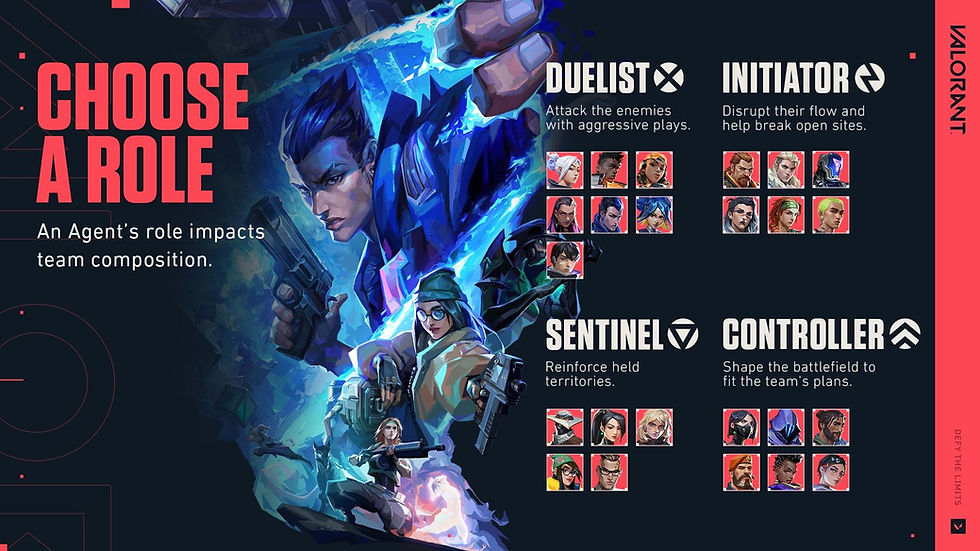
Agents are at the heart of Valorant's gameplay. Each character has unique abilities designed to support a particular role, and choosing the right combination can make a major difference.
Duelists
Duelists such as Jett, Reyna, and Phoenix specialize in taking fights and creating opportunities for their teammates. They often lead attacks and help the team gain control of a site.
Initiators
Initiators like Sova and Breach gather information, disrupt opponents, and help teammates enter dangerous areas. Their abilities make it easier to challenge defenders holding strong positions.
Controllers
Controllers such as Brimstone and Omen use smokes and other abilities to block enemy vision, control important areas, and create safer opportunities for attacking or defending.
Sentinels
Sentinels, including Sage, Cypher, and Killjoy, focus on defense, information gathering, and protecting the team's flanks. Their abilities can slow enemy pushes and make it harder for opponents to take control of a site.
A balanced team usually combines these roles so that players can support one another rather than relying entirely on individual aim.
Which Valorant Agent Should Beginners Choose?
Your first main should be an agent whose abilities are easy to understand and useful in most situations.
Sage is a strong starting choice. Her healing, slowing abilities, defensive wall, and resurrection ultimate teach useful team-support habits without requiring complicated setups.
Brimstone is another beginner-friendly option. His smokes are straightforward to deploy, allowing new players to learn map control and coordinated attacks.
Phoenix can help players learn aggressive entry play, while Sova introduces the value of gathering information before pushing a site.
Unlocking additional agents depends on the available recruitment system and progression options. New players should check the current in-game agent menu for recruitment events, Kingdom Credit costs, and other eligibility requirements.
Rather than constantly switching characters, spend time learning one or two agents well before expanding your roster.

Best Weapons for Valorant Beginners
Valorant features sidearms, SMGs, rifles, shotguns, sniper rifles, and machine guns. Each category serves a different purpose, but two rifles deserve particular attention.
Phantom: Offers a forgiving firing experience at close and medium range, making it a comfortable choice for controlled bursts and sprays.
Vandal: Delivers a one-shot headshot kill against an unarmored or armored opponent at any range, provided the shot connects to the head.
Spectre: A useful SMG for close-range fights and rounds when your team has a limited budget.
Ghost: A reliable pistol for players who prefer accurate shots over continuous firing.
Operator: A powerful sniper rifle suited to holding long sightlines and punishing exposed opponents.
The Phantom and Vandal are both excellent choices for learning rifle mechanics. Try them in the practice range to understand their recoil and firing patterns.
Remember that accuracy matters more than spraying as many bullets as possible. Keep your crosshair near head height, fire in controlled bursts, and stop moving before shooting.

Valorant Maps and Tactical Awareness
Every map has different routes, sightlines, and site layouts. Learning these features helps you anticipate enemy movements and make better decisions.
Maps such as Bind, Haven, Lotus, Pearl, Split, Fracture, and Breeze illustrate how different layouts influence strategy. Haven and Lotus feature three bomb sites, while Bind's teleporters create unique rotation opportunities.
Map availability can change between competitive updates, so check the current in-game map pool before preparing for ranked matches.
Two habits will improve your map awareness immediately:
Learn callouts. Knowing the names of important locations helps you communicate enemy positions accurately.
Check the minimap. It provides information about teammates, revealed enemies, and the Spike's location.
Instead of saying, “Someone might be near B,” give your team actionable information, such as the enemy's approximate location, number, and direction of movement.
Best Valorant Settings for New Players
Good settings make the game easier to control, but there is no universal configuration that works for everyone.
Mouse Sensitivity and Crosshair
Many players experiment with 800 DPI and an in-game sensitivity around 0.35–0.45, although the best setting depends on personal preference and mouse control.
Choose a small, clearly visible crosshair that stands out against different backgrounds. Keep it relatively simple so it doesn't obscure opponents during fights.
Graphics and Performance
If your computer struggles to maintain a stable frame rate, try lowering demanding graphics settings and disabling unnecessary visual effects.
Full-screen mode and an appropriate resolution can also help provide a consistent experience. Multithreaded Rendering may improve performance on supported systems.
Prioritize stable frame rates and responsive controls over visual effects. A consistent experience makes it easier to develop reliable aiming habits.
Essential Valorant Tips to Win More Rounds
Improvement comes from practicing fundamentals rather than chasing spectacular plays.
Keep your crosshair at head level. This reduces the distance you need to move your aim when an enemy appears.
Stop before shooting. Running and firing significantly reduces accuracy. Practice counter-strafing or releasing movement keys before taking a shot.
Use abilities with a purpose. Smokes, flashes, and recon tools should help your team accomplish a specific objective.
Communicate clearly. Short, accurate callouts are more useful than constant commentary.
Play with your teammates. Coordinated pushes and crossfires are often more effective than isolated fights.
Manage your credits. Coordinate purchases and save when necessary instead of repeatedly buying equipment you cannot replace.
Practice in Deathmatch. Use these sessions to improve crosshair placement, reaction time, and weapon control.
The most important lesson is that abilities support gunplay rather than replace it. A perfectly timed flash or smoke can create an advantage, but your team still needs to capitalize on that opportunity.
Can You Play Valorant on Mac, Linux, or Mobile?
Valorant's platform availability is an important consideration for new players.
The PC version officially supports Windows, while Vanguard's anti-cheat requirements prevent native support on macOS and Linux. Compatibility workarounds may be unreliable, so check Riot's current support documentation before attempting alternative installations.
Valorant is also available on supported PlayStation 5 and Xbox Series X|S consoles, with console-specific matchmaking and controls. PlayStation 4 is not an officially supported platform.
Riot has announced development of a mobile version, but players should consult official announcements for its current release status and regional availability.
Final Thoughts
Learning how to play Valorant takes time, but the fundamentals are surprisingly straightforward once you break them down. Start with an accessible agent, practice with the Phantom or Vandal, learn one map at a time, and focus on positioning before attempting complicated strategies.
You don't need to win every duel to contribute to your team. Smart utility usage, accurate callouts, and good economic decisions can make you valuable even while your aim is developing.
As you improve, you'll discover that Valorant is about much more than shooting. It's a tactical experience where teamwork, preparation, and decision-making often determine who wins the final round.
For players exploring other competitive experiences, blockchain games offer another side of gaming, with some titles adding player-owned digital assets and blockchain-based economies to their gameplay.
Valorant Beginner FAQs
Is Valorant free to play?
Yes. Valorant is free to play, although optional purchases are available for cosmetic items and other in-game content.
What is the best game mode for beginners?
Unrated is ideal for learning the standard rules without affecting your competitive rank. Deathmatch is useful for practicing aim, while Swift Play offers shorter matches.
What is the best gun for beginners?
The Phantom is a forgiving choice for close-to-medium-range fights, while the Vandal is excellent for players who prefer precise shots and consistent headshot damage.
Can you play Valorant with a controller?
Yes, on supported console versions. The PC version is designed primarily for mouse-and-keyboard controls.
Is Valorant available on mobile?
Riot has announced a mobile version, but its current availability should be confirmed through official announcements.
How can you rank up faster in Valorant?
Focus on crosshair placement, positioning, communication, and learning a small group of agents. Consistent fundamentals and coordinated teamwork are more reliable than chasing kills alone.


Comments