
Bladerite Rivals BRMC Showdown

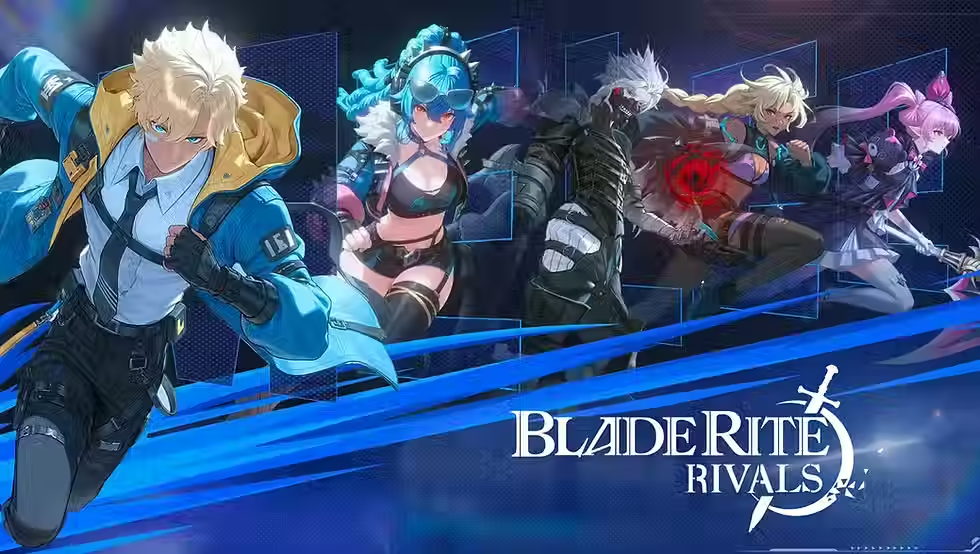
The competitive scene in blockchain gaming is heating up, and Bladerite: Rivals is stepping directly into the spotlight with its new BRMC Selection Arena Conquest event. Designed as a pure skill-based competition, the tournament gives players a chance to prove themselves in one of the most ambitious melee-focused Web3 games currently in beta.
Unlike many titles in the wider world of <a href="https://www.nftplaygrounds.com/">blockchain games</a>, Bladerite: Rivals is making a very public promise: no pay-to-win systems, no luck-based outcomes, and no shortcuts. Just skill, timing, strategy, and consistency.
The event officially launched on May 7 and runs through May 28, with daily battle windows taking place between 17:00 and 19:00 local time across supported regions.
What Is the BRMC Selection Arena Conquest?
The BRMC Selection Arena Conquest is the headline competitive event for the current 6-7 Beta cycle of Bladerite: Rivals. It serves as both a tournament and a large-scale test of the game’s competitive systems before wider release.
At the center of the event is the BRMC title, short for BladeRite Master of Ceremonies. This designation is awarded to the top-performing player during the competition window, effectively crowning the first official champion of the rebranded game.
The rewards are substantial, especially for a beta tournament. The winner receives:
A Xiaomi POCO X8 Pro Max smartphone
Exclusive in-game skins
Additional grand prizes
Official BRMC recognition within the community
Meanwhile, all participants also have opportunities to earn Google Play Gift Cards and beta rewards simply by competing.
A Skill-First Approach to Blockchain Gaming
One of the most interesting aspects of this tournament is how aggressively the developers are leaning into competitive integrity.
The studio repeatedly emphasizes three key ideas:
No pay-to-win
No luck-based outcomes
Skill determines victory
That positioning matters a lot in the modern <a href="https://www.nftplaygrounds.com/">blockchain gaming ecosystem</a>. Many Web3 games have struggled to balance NFT ownership and token economies with fair competition. Players often worry that spending money creates unfair advantages.
Bladerite: Rivals is trying to separate itself from that model.
The tournament structure rewards mechanical mastery, smart decision-making, and consistency during the three-week ladder climb. Success comes from understanding combat systems, predicting opponents, and adapting under pressure rather than owning expensive assets.
That makes the BRMC event more than just a tournament. It’s effectively a public stress test for the game’s competitive philosophy.
How the Tournament Works
The format itself is relatively straightforward but highly demanding for competitive players.
The tournament spans 22 competition days from May 7 through May 28. Every day, players can enter arena matches during the fixed two-hour competitive window.
Performance across matches contributes to overall rankings, meaning consistency matters far more than isolated victories.
The tournament currently supports players in six Android beta regions:
Indonesia
Philippines
Thailand
Brazil
Egypt
Iraq
Players in those regions can download the game directly through Google Play and immediately begin competing.
The limited daily schedule also creates an interesting competitive dynamic. Players who consistently participate during the daily windows naturally gain more opportunities to climb rankings and refine their strategies.
What Makes Bladerite Rivals Different?
For players unfamiliar with the title, Bladerite: Rivals is a fantasy melee battle royale developed by Seeds (LUSHENG Pte. Ltd).
The game originally appeared under the name Project A: Melee Battle Royale before being rebranded earlier this year.
Instead of focusing on firearms like traditional battle royale games, Bladerite: Rivals builds its combat entirely around melee fighting, abilities, and hero-based gameplay.
Matches feature:
20 players
Roughly seven-minute rounds
Weapon scavenging
Hero abilities
Fast-paced elimination gameplay
The shorter match structure creates a much tighter competitive rhythm compared to traditional battle royale games.
The Lethal Triangle Combat System
The heart of the gameplay is the game’s Lethal Triangle combat mechanic.
The system works like this:
Light Attacks beat Heavy Attacks
Heavy Attacks break Blocks
Blocks stop Light Attacks
This creates a constant rock-paper-scissors mind game where reading your opponent becomes critical.
Victory is rarely about button mashing. Instead, players need to predict enemy behavior, manage timing carefully, and chain together dodges, parries, and combos effectively.
That design philosophy is one of the biggest reasons the developers believe the game can support long-term esports-style competition.
The current beta also features more than 20 heroes across multiple archetypes, including:
Assassins
Warriors
Shield tanks
Magic casters
The newest addition, Candice, introduces unique ultimate abilities that further expand team compositions and combat strategies.
NFTs and the Player-Driven Economy
Like many modern <a href="https://www.nftplaygrounds.com/">blockchain games</a>, Bladerite: Rivals includes Web3 systems, but the implementation is intentionally focused on customization rather than raw power.
The game’s economy revolves around Patterns, collectible weapon enhancements that players can gather, upgrade, and trade.
The broader franchise also includes Hero NFTs across several rarity tiers:
Common
Rare
Epic
Legendary
Importantly, the developers state that these NFT elements are primarily cosmetic and identity-driven rather than direct power boosts.
Hero skins change appearance without dramatically altering gameplay balance, helping the game maintain its competitive integrity goals.
The Pattern Gear system extends this economy further while still attempting to avoid pay-to-win concerns.
Why the BRMC Event Matters
The BRMC Selection Arena Conquest could become a defining moment for Bladerite: Rivals.
If the event successfully produces a respected champion through purely skill-based competition, it gives the studio strong evidence that a competitive Web3 battle royale can work without unfair monetization.
That would be a meaningful achievement in the wider blockchain gaming industry.
At the same time, the tournament provides valuable testing data before full release. Since beta progression will not carry over permanently, every match effectively becomes both a competition and a live balance test.
The developers are clearly using this event to evaluate:
Combat balance
Server stability
Matchmaking quality
Competitive fairness
Player retention
The results could heavily influence the game’s direction moving forward.
The Road Ahead for Bladerite Rivals
The first official BRMC champion will be crowned after the May 28 conclusion of the tournament.
By then, the developers should have a much clearer understanding of whether their vision for a skill-first blockchain battle royale truly resonates with players.
For now, the formula is simple:
Enter the arena. Master the combat. Climb the rankings.
With daily competition windows, meaningful rewards, and a major focus on competitive integrity, Bladerite: Rivals is positioning itself as one of the more interesting competitive projects currently emerging in the world of Web3 gaming.
And if the BRMC Selection Arena Conquest succeeds, it could become one of the stronger examples of how competitive multiplayer and blockchain systems can coexist without compromising gameplay fairness.


Comments