
Fableborne Season 4 and Power Rise

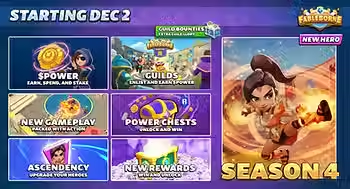
With the Power Protocol making its long-awaited debut and Fableborne Season 4 kicking off in full force, this week marks one of the biggest moments yet for Pixion Games’ expanding ecosystem. The launch of the $POWER token on December 5 ties together gameplay, NFTs, guild systems, and a new era of cross-game utility—something fans of modern blockchain games have been eagerly waiting for.
Let’s break down everything happening in Season 4, what $POWER brings to the table, and how players can jump into the action.
$POWER Token Set to Launch on December 5
Pixion Games has officially confirmed that the $POWER Token Generation Event (TGE) goes live on December 5, with the first trading venue being Binance Alpha. Eligible users can claim an airdrop using their Alpha Points, marking the token’s first major distribution opportunity.
The timing couldn’t be better—Fableborne Season 4 has just launched, and $POWER is already deeply integrated into the game’s economy. Players can use it to buy Diamonds, Chests, Guild Bounties, and various in-game items through the official webshop. It’s also used for staking and entering premium events, creating new layers of reward-earning opportunities.
Tokenomics: Supply, Allocation, and Early Unlocks
According to the Power Protocol whitepaper, $POWER is the backbone of a three-layered ecosystem covering gaming, infrastructure, and incubation.
Here’s a snapshot of the token structure:
Total Supply: 1 billion
Community Rewards & Emissions: 37.2%
Ecosystem Fund: 28%
Staking Rewards via Kingdom NFTs: 4%
Investors, Team, and Advisors: Small allocations with long-term vesting
Unlocked at TGE:
5% for liquidity
13.2% of community rewards
Notably, no team or advisor tokens unlock at TGE, allowing for a clean and community-first launch.
How $POWER Functions Inside Fableborne
$POWER isn’t just another in-game currency. Unlike Diamonds, Shards, and Potions, it operates across multiple systems and future titles within the Pixion ecosystem.
Inside Fableborne Season 4, players can use $POWER to:
Purchase premium items and event entries
Stake Kingdom NFTs for seasonal rewards
Participate in premium events that offer real token payouts
Acquire POWER Chests and Guild Bounties
This makes $POWER the key connector between gameplay, earning loops, and larger Power Protocol utilities.
Season 4: The Biggest Fableborne Update Yet
Season 4 officially launched on December 2 and represents the game’s largest update to date. Bringing together content originally planned for a future season, this update marks a turning point for the Ronin-based action-strategy title.
Key highlights include:
The new Guild System
The introduction of Ember, a new fire-based melee hero
Guild Bounties and rotating raid-based objectives
Ascendency—an expanded hero progression system
A full schedule of PvP, PvE, and premium events through January 5
Let’s dig into some of these new systems.
Guilds, Bounties, and Revenue-Sharing Prize Pools
Guilds are the headline feature of Season 4. Players can now form or join guilds and compete in guild-based challenges. What makes this especially interesting is the new revenue share model:
70% of all webshop revenue (excluding POWER Chests) goes directly into a seasonal prize pool.
Rewards are paid out in $POWER.
Guild leaders earn a proportional share of the rewards their guild members generate.
Guild Bounties bring dynamic objectives that shift from raid to raid. Completing these earns Guild Glory, which contributes to progression and unlocks Glory Chests filled with valuable rewards.
Ember, Ascendency, and Progression
Joining the hero roster this season is Ember, a high-skill melee hero with explosive fire-based attacks. She offers a more technical playstyle for players who enjoy fast-paced combat and tight timing windows.
Season 4 also introduces the Ascendency System, allowing players to push heroes and units beyond former level caps. Each ascension unlocks five additional levels plus valuable rewards such as:
Ability Tomes
Currencies
Progression resources
These tomes allow players to mix abilities across heroes—a huge shift for strategy and min-max gameplay.
Events, Rewards, and How to Earn $POWER
Season 4 runs a continuous calendar of PvE, PvP, and premium events through January 5. Here’s how the reward structure breaks down:
PvE Events (e.g., “Supplies Run”)
Earn Supply NFTs
Gain Hero XP Potions
Obtain Guild Valor
PvP Events (e.g., “Resource Raid,” “Power Harvest”)
Compete for Diamonds
Earn leaderboard chests
Win Supply NFTs
Premium Events
Require gem entry
Provide 12 raid tickets
Reward $POWER, Kingdom NFTs, Supply NFTs, Guild Energy, and lootboxes
Importantly, premium events are the only way to directly earn $POWER through gameplay.

Kingdom NFTs and the Merge-to-Mint Staking Engine
The Kingdom NFT collection is central to Season 4’s staking ecosystem. With an initial cap of 7,250 NFTs, players can merge NFTs to increase tier and rarity, using supply resources like Wood, Iron, and Runestones.
Staking works as follows:
Each staked Kingdom generates points based on rarity and tier
Points accumulate daily
Top performers earn from a 1.66 million $POWER season pool
This system encourages active management, merging, and strategic staking—perfect for players wanting deeper blockchain-driven gameplay loops.
Power Protocol: Expanding Beyond Fableborne
$POWER is built to be more than a Fableborne token. Pixion plans to expand the Power Protocol through SDKs, APIs, and partnerships with other studios.
Future growth will include:
Integrating $POWER into multiple new games
Launching Power Labs titles
Increasing token sinks across products
Bringing more IPs under the protocol umbrella
Each new integration boosts utility, staking demand, and long-term ecosystem value.
How to Join Season 4 Today
Getting started is easy:
Download Fableborne on the App Store or Google Play.
Create a Pixion ID to save rewards and progress.
Start raiding, defending, leveling, and competing.
Explore NFTs and premium events if you want to earn deeper rewards.
Season 4 runs until January 5, with the first Guild Season scheduled from December 8 to December 24.


Comments